Life Path Number 1: Traits, Strengths and Blind Spots
Count the things you have started in the last two years. Now count the ones that are finished. For most people on Life Path 1 the first number is much larger, and the gap is the whole reading.
Every guide calls 1 the leader. Leading is what happens after the start, and plenty of 1s never get that far. What follows includes the half that does not flatter.
How to know if this is your number
Your Life Path comes from the whole date of birth, not from the birthday alone. Reduce the day, the month and the year each to a single digit, add the three results, then reduce once more. Take 1 January 1970: 1 + 1 + 8 = 10, then 1 + 0 = 1. Totals landing on 11, 22 or 33 are normally held rather than reduced.
Not sure if this is your number? Find out in 30 seconds.
Calculate my Life Path — free →What Life Path 1 actually means
Strip the leadership language away and 1 is the number of the first move. It is read as self-direction, decisiveness and a low tolerance for being managed. Not authority, not popularity, not success. The tradition places 1 at the beginning of a cycle, which is why the descriptions cluster around origination rather than maintenance.
The strengths
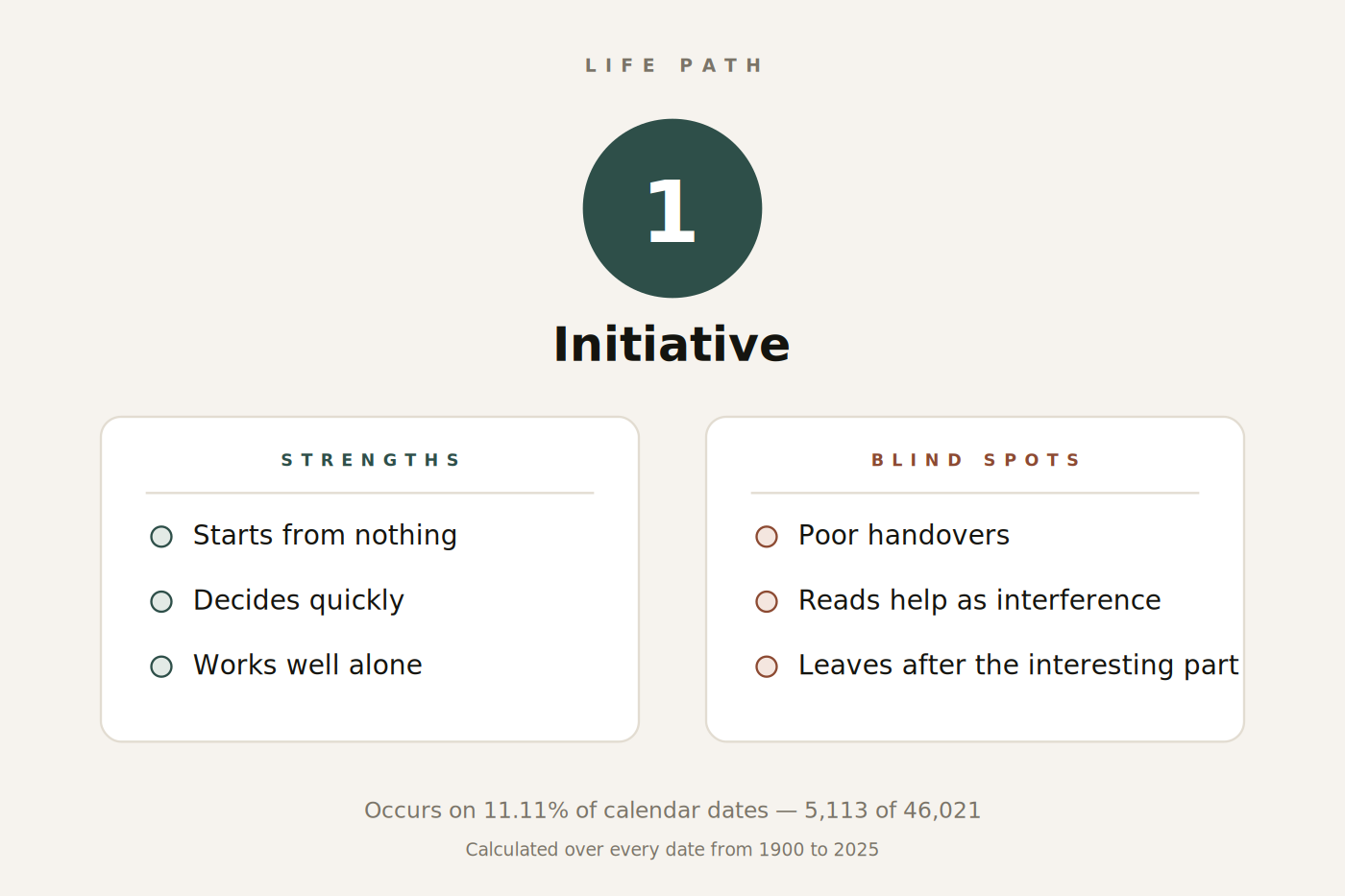
What the 1 reading gets right is a tolerance for the blank page. Where other numbers need a brief, a team or a precedent, 1 is described as able to move without one. Decisions come fast and get revised in motion rather than in planning. Solitude is not a cost for this number; it is the working condition. In a group, 1 is the person who converts a long discussion into a first attempt.
- Starts from nothing
- Decides quickly
- Works well alone
The blind spots
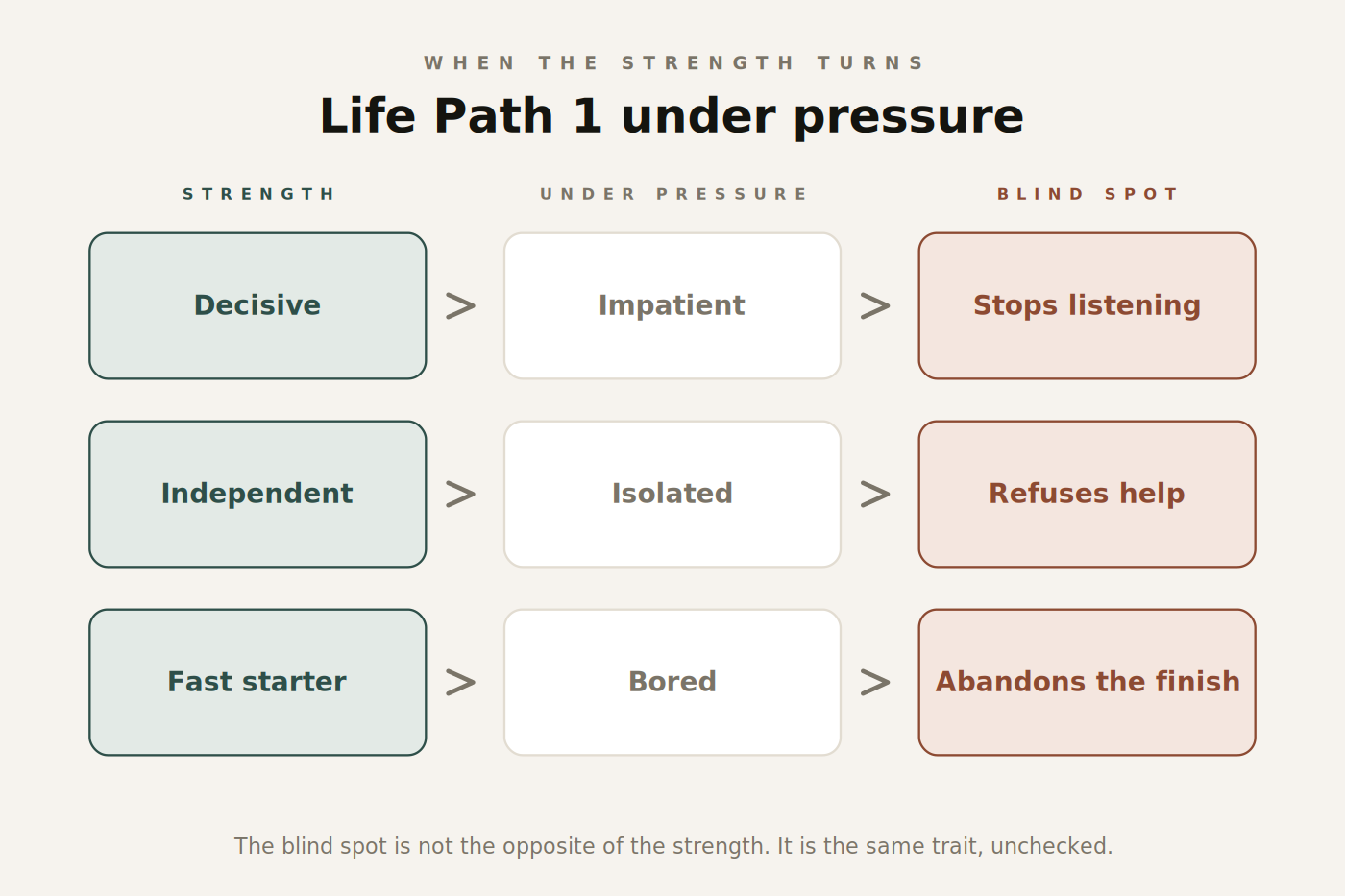
Now the half that does not get printed. Here is what the profiles skip. The same independence that starts the project makes the handover bad: 1 is described as holding detail in their own head and resenting the time it takes to hand it over. Input arrives as interference rather than help. And the reading has a quiet failure mode, which is the gap between starting and finishing. The interesting part of most work is the first twenty per cent. A 1 who never learns to care about the other eighty leaves a long trail of promising beginnings.
- Poor handovers
- Reads help as interference
- Leaves after the interesting part
When the strength turns
At work and with other people
At work, the 1 reading shows up as a preference for owning an outcome rather than a task, and as visible discomfort when the work is closely supervised. Groups usually place a 1 at the front of a new thing and then discover the handover is the hard part. With other people, the same pattern appears as a reluctance to be managed inside a relationship. The tradition pairs 1 well with numbers that take over the maintenance, and badly with another 1, on the grounds that two people who both want the first move spend a lot of time negotiating who gets it.
What Life Path 1 gets confused with
Life Path 1 is most often confused with 8, because both read as driving. The distinction in the tradition is what each one wants. A 1 wants autonomy: the first move, made without permission. An 8 wants consequence: the decision that carries weight. Put plainly, a 1 would rather run a small thing alone than a large thing with a board attached, and an 8 would make the opposite trade every time. If the description of 1 feels almost right but slightly too small, read 8 next.
How common is Life Path 1 really?
Life Path 1 lands on 11.11% of calendar dates, 5,113 out of 46,021 between 1900 and 2025. That is one date in nine, which is what you would expect if the nine numbers were spread evenly, and they almost are. No single-digit Life Path is rarer than another. The gap between the most and least common is a single date. Anyone describing your 1 as rare is either careless or selling something.
What the number cannot tell you
Numerology is a symbolic system, not a measurement. There is no evidence that the digits of a birth date predict behaviour, and nothing about 1 makes anyone a leader, a founder or a success. Read the description as a prompt, and treat the parts that do not fit as information rather than error.
Questions that keep coming up
Does Life Path 1 mean I should be self-employed?
No. The reading describes a preference for starting and for working unmanaged. Plenty of people with that preference are better paid and better used inside an organisation. The number is not career advice.
My birthday is the 1st. Is that the same thing?
No. The day of the month gives a separate number, sometimes called the Birthday number. The Life Path comes from the whole date. They can differ, and often do.
Which numbers does 1 work with?
The tradition suggests the steadier numbers, particularly 2 and 6, because they absorb the follow-through. Treat compatibility readings as a way to name a dynamic you already noticed, not as a prediction about any actual relationship.
Three ways to test this on yourself
Descriptions in this field fit almost anybody, so the only honest way to read one is to try to break it. Three checks:
- Count what you started in the last two years against what you finished.
- Recall the last time somebody offered to help with something already underway. Gratitude, or irritation?
- Name one thing you left at the exact point it turned into maintenance.
Where this stops being enough
If the checks landed, you already know the problem is not starting. Build the handover before the interesting part ends, because that is the exact moment a 1 stops paying attention. And if one check missed entirely, that is worth more than the two that hit: the Life Path is one of four core numbers, and a miss usually means another one of them is doing the steering.
Keep reading
Curious what your own numbers say?
Calculate your Life Path number free in 30 seconds — then unlock your full, personal reading.
Calculate my number →Or gift a reading to someone you love.