Numerology for Dummies: The Four Things Other Guides Leave Out
Numerology began as a secret. The Pythagoreans, the first group in the West to read character out of numbers, were a closed society bound by oaths of silence. The word occult, attached to this subject ever since, is only the Latin for hidden.
Most of that secrecy is gone. What survives is not ancient wisdom. It is the short list of things practitioners know and beginner guides quietly leave out. There are four of them, and all four are on this page.
The system itself is simple. Add the digits of a number together until one digit is left, then read what that digit means. If you can add, you can do numerology.
What numerology actually is, and how old it really is
Numerology is a symbolic system. It gives traits to each digit from 1 to 9, then uses your birth date and name to decide which apply to you.
The first omission. Number-symbol traditions really are ancient, and appear in Greek, Hebrew and Vedic sources. The version used on almost every website today is not. It was assembled in the early twentieth century by a small group of American writers. Both facts are true at once, and only the flattering one gets printed.
The story told about that society is that one member revealed a mathematical result the group wanted kept quiet, and drowned at sea for it. Whether it happened is unknown. It is a legend, repeated for two and a half thousand years, and legends survive for a reason.
Two things numerology is not. It is not astrology: the Western system uses no planets and no star positions. Some Indian and Chaldean schools do link numbers to planets, which is where the confusion starts. And it is not a measurement. The numbers come from arithmetic on data you supply.
Not sure if this is your number? Find out in 30 seconds.
Calculate my Life Path — free →How to calculate your Life Path number
The Life Path number is the main number in the system. It comes from your full date of birth. Four steps.
1. Reduce the day to one digit.
2. Reduce the month to one digit. November, month 11, is the one case where many schools keep both digits.
3. Reduce the year to one digit.
4. Add the three results, then reduce once more.
To reduce a number, add its digits together. Repeat until one digit is left. Here is 14 March 1990 done in full.
- Day: 14 becomes 1 + 4 = 5
- Month: 3 is already one digit
- Year: 1990 becomes 1 + 9 + 9 + 0 = 19, then 1 + 9 = 10, then 1 + 0 = 1
- Total: 5 + 3 + 1 = 9
The Life Path number is 9.
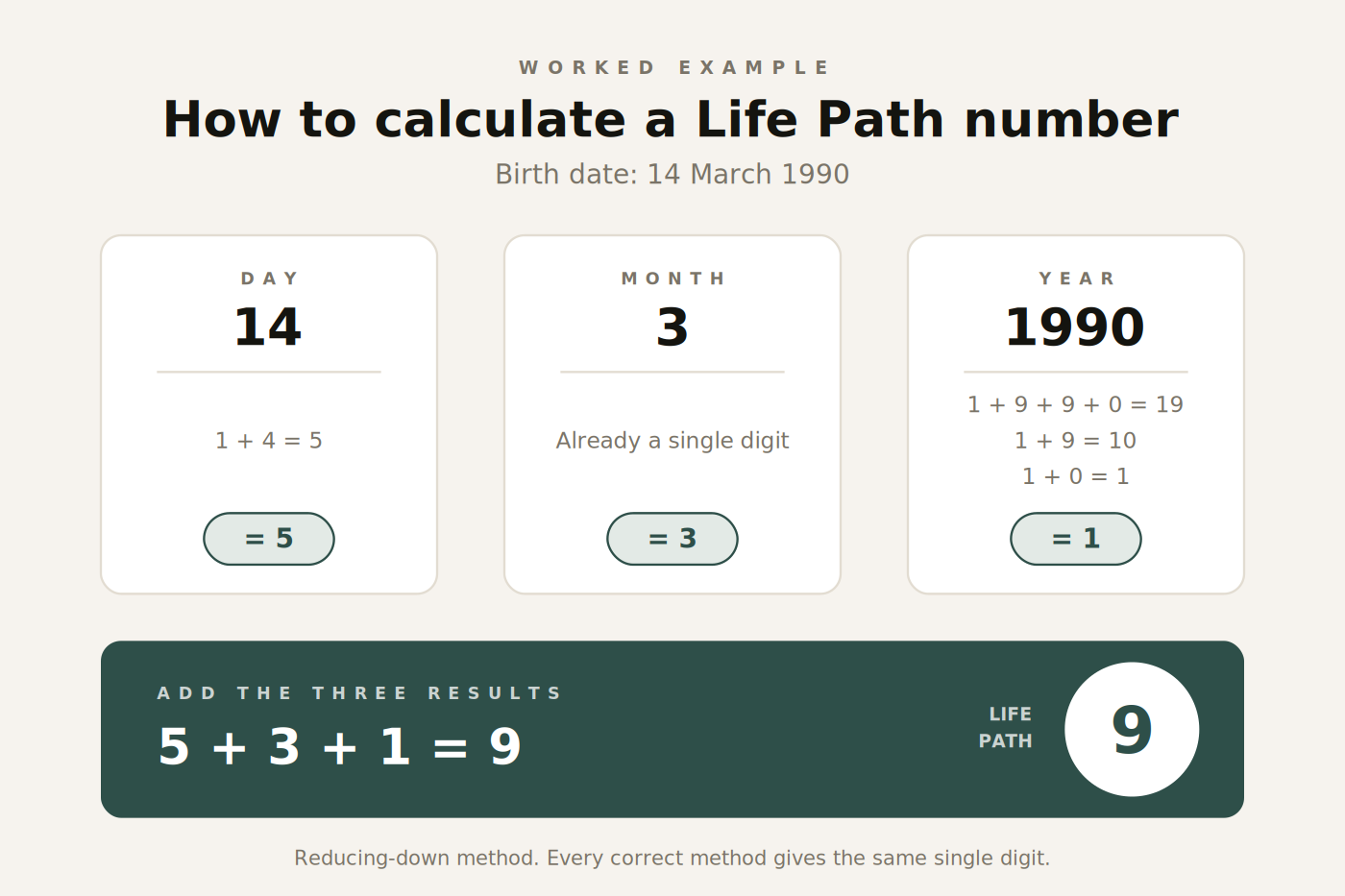
The second omission, and the serious one. Some sources add every digit of the date in one line instead of reducing each part first. Both routes always give the same single digit; the arithmetic guarantees it. They differ only over master numbers: on about 14 birth dates in 100, one route passes through 11, 22 or 33 and the other does not. Pick one method and keep to it, or your master number will appear and disappear.
What the nine numbers mean
Each digit carries a short list of traits. Beginners learn one keyword per number, then add detail.
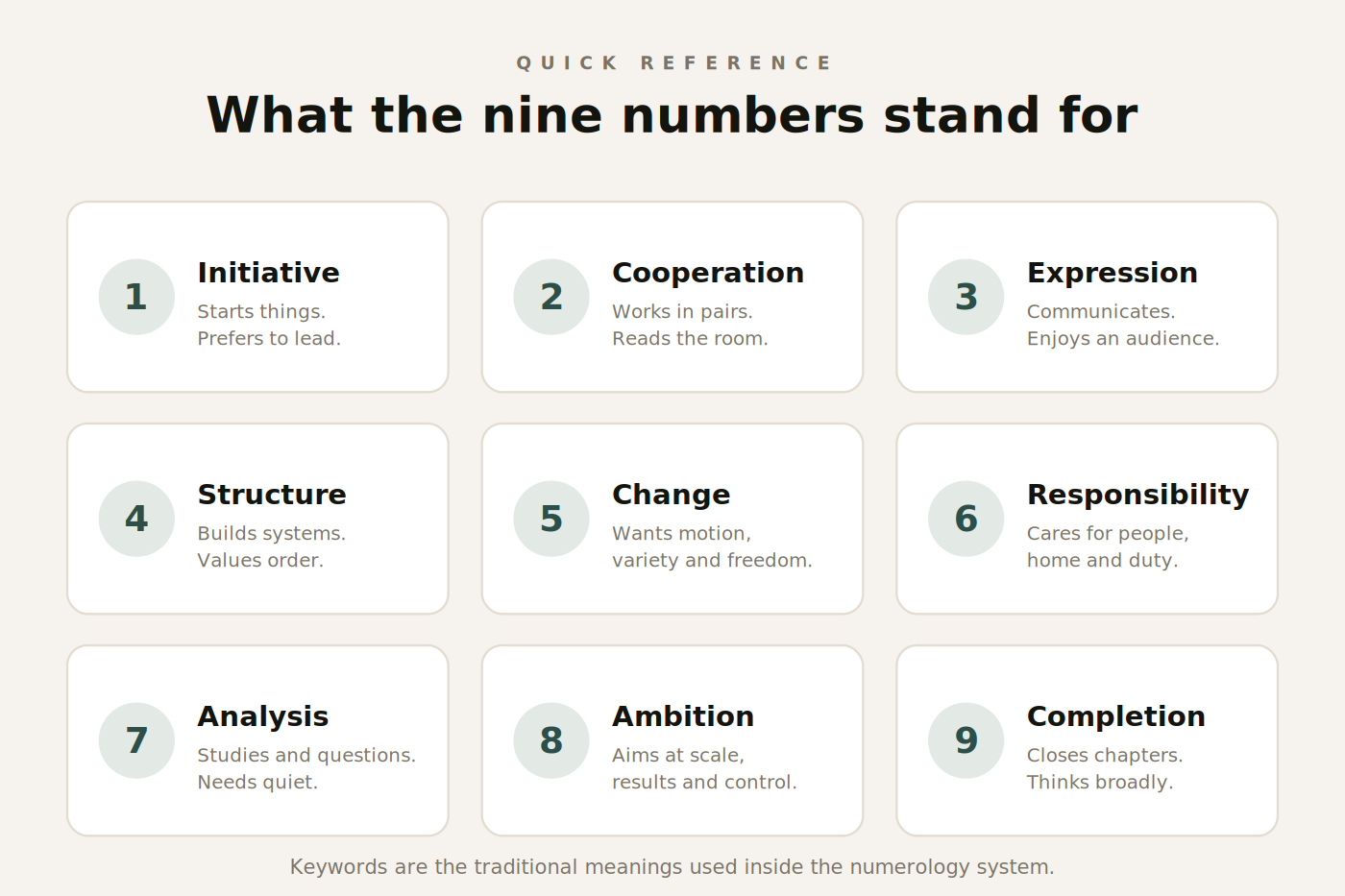
Read your number as a tendency, not a fate. The descriptions are broad on purpose. That is the system’s main feature and its main weakness.
Master numbers: 11, 22 and 33
One exception to the reducing rule: if a total lands on 11, 22 or 33, most practitioners stop there.
These are the master numbers. Inside the system, 11 is an intense 2, 22 a builder 4, and 33 a teaching 6. Not every school uses 33.
Is your number rare? The arithmetic nobody runs
The fourth omission. This is the part that gets invented most often, so here is the arithmetic. Across all 46,021 calendar dates from 1900 to 2025, the nine Life Path numbers come out almost exactly even: each lands on 11.11% of dates. The gap between the most common and the least common is one date.
So no Life Path is rarer than another. Anyone who tells you yours is unusual is selling something.
The rarity sits with the master numbers. Over the same dates, 11 appears on 6.34%, 22 on 3.18%, and 33 on 0.68%, which is roughly one date in 147. About one date in ten produces a master number of some kind.
Note the wording: dates, not people. Births are not spread evenly across the calendar, so real-population figures shift a little.
The three numbers hidden in your name
Three more numbers come from your name, where each letter maps to a digit from 1 to 9.
- Expression number. From all letters of your full birth name. It points at natural ability.
- Soul Urge number. From the vowels only. It points at motivation.
- Personality number. From the consonants only. It points at first impression.
The third omission. You need the full 26-letter chart, and you pass over the name three times: every letter, then the vowels, then the consonants. And the letter Y is a fork in the road nobody warns you about. It counts as a vowel in some names and a consonant in others, and your school decides which. Two practitioners can read the same name, disagree, and both be following the rules.
Where beginners quietly give up
The four numbers rarely agree. A Life Path 4 wants structure. An Expression 5 wants motion. Neither keyword describes that person alone. This is where most beginners stop.
A keyword list stops helping here. The useful reading is not the four numbers but what they do to each other, and which takes over under pressure. That is cross-referencing, and it is where pen and paper get tedious.
What numerology cannot do, and why it still feels accurate
There is no scientific evidence that the digits of a birth date predict personality or future events. Numerology has no known mechanism and no controlled research behind it.
Now the last thing that rarely gets printed. The descriptions are wide enough to fit almost anybody. Read the entry for 5, then the entry for 3. Most people see themselves in both. Psychologists call this the Barnum effect, and it is the mechanism behind every horoscope you have ever found accurate.
Knowing how the trick works does not spoil it. It tells you what the tool is actually for.
Use numerology for what it does well: a structured prompt for self-reflection, a vocabulary for your own patterns, and a way to make a decision explicit before you take it.
Do not use it for medical, legal or financial decisions. If a reading points at leaving a job, treat it as a question to think about, not an instruction to obey.
Common beginner questions
Do I need to pay for a report?
Not for the Life Path. That is a two-minute calculation, and this guide has all of it. A paid report buys the rest: the letter chart applied for you, the four numbers cross-referenced, the contradictions written out. It buys time and interpretation, not accuracy.
Is numerology the same as angel numbers?
No. Angel numbers are repeated digits that people notice during the day, such as 11:11. That is a separate practice with different rules.
Start with one number
Work out your Life Path with a pen. Read the keyword. Then ask the question that matters: where does this match my behaviour, and where does it not?
The second half of that question is the useful one. It is also where one number stops being enough. The other three, and the way they pull against each other, are a letter chart and an afternoon by hand, or a few minutes with a tool that does the cross-referencing for you.
Keep reading
Curious what your own numbers say?
Calculate your Life Path number free in 30 seconds — then unlock your full, personal reading.
Calculate my number →Or gift a reading to someone you love.