Life Path Number 6: Traits, Strengths and Blind Spots
Somebody in your life is depending on you for something nobody ever formally asked you to do. If you can name them in under five seconds, keep reading.
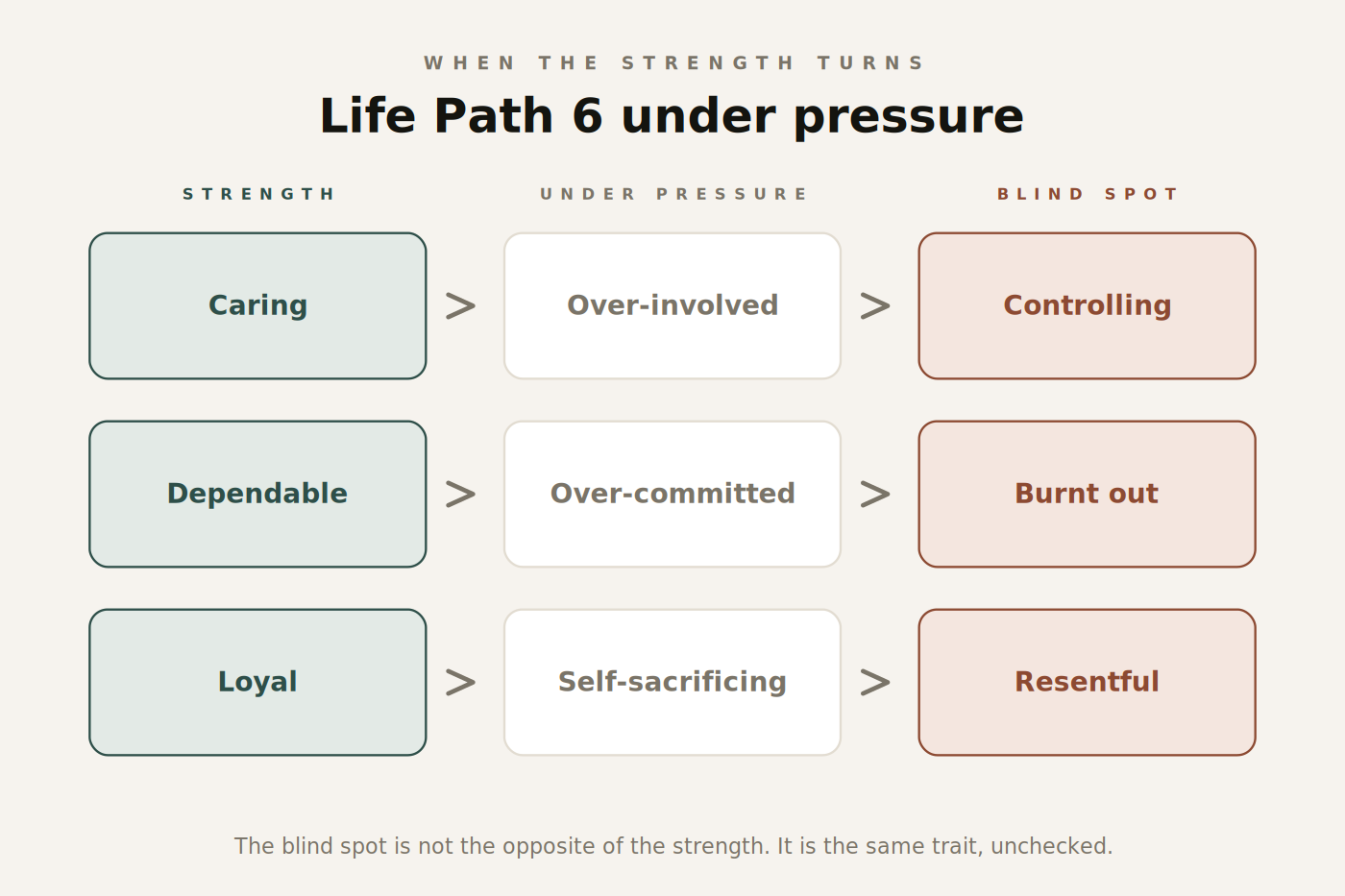
Life Path 6 is the caretaker number, and most pages about it read like a thank-you card. The older sources are harder: the instinct that makes a 6 dependable is the same one that makes a 6 controlling, and the distance between those is short.
How to know if this is your number
Start from the entire birth date. Each of the three parts reduces to one digit, the results are added, and the total reduces again. For 6 January 1970 that gives 6 + 1 + 8 = 15, then 1 + 5 = 6. A total reaching 33 is usually kept as a master number, which is directly relevant to this number and is explained below.
Not sure if this is your number? Find out in 30 seconds.
Calculate my Life Path — free →What Life Path 6 actually means
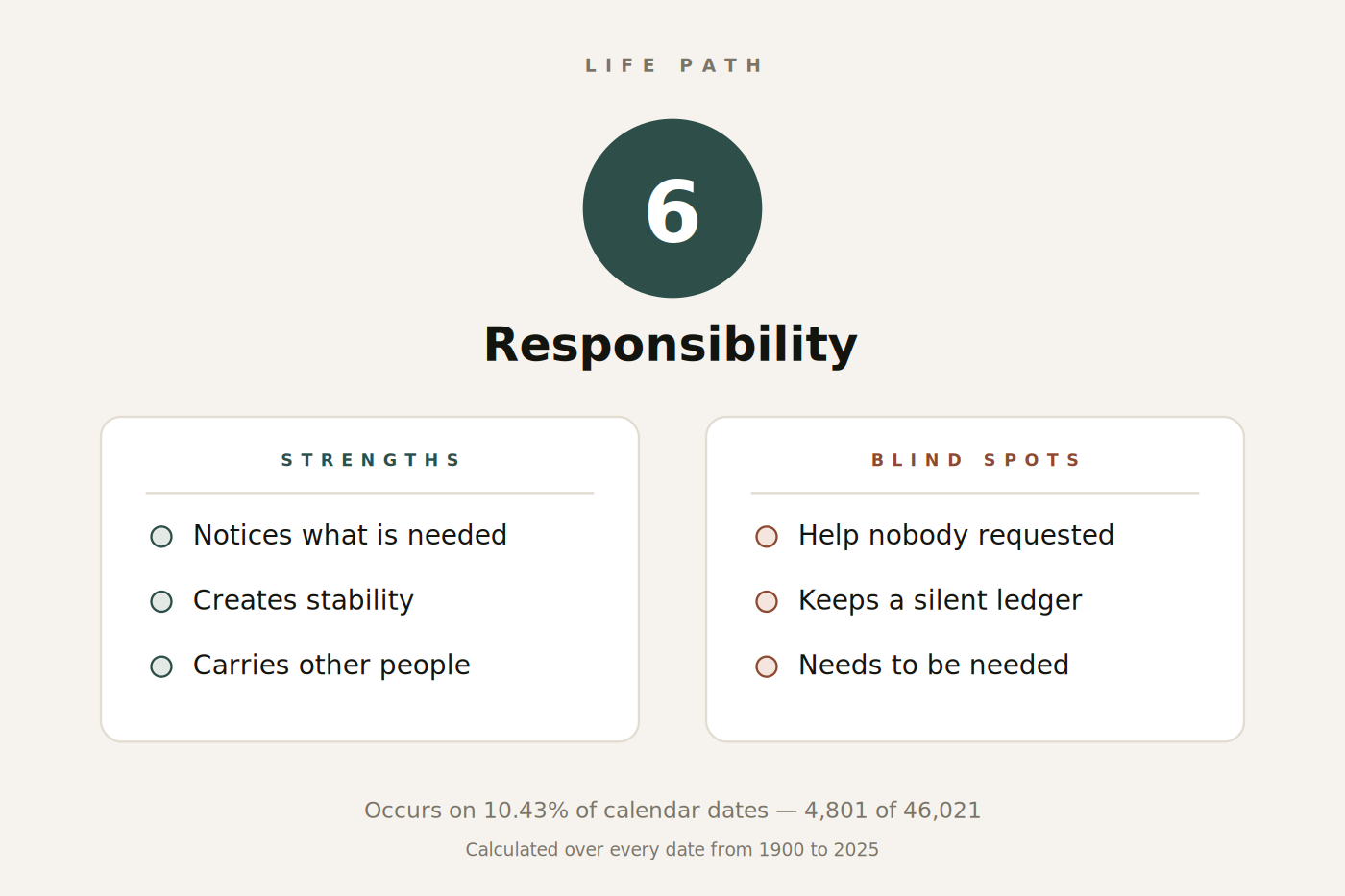
The tradition calls 6 the number of responsibility, and means the word literally. It is read as care, duty and an eye for what a household or a team needs before anyone asks. The tradition attaches it to home, obligation and repair. Where 5 is read through what it leaves, 6 is read through what it carries, and carrying is treated as both the gift and the bill.
The strengths
Anticipation is the trait: seeing the gap before anybody names it. A 6 is read as seeing the gap before it becomes a problem and closing it without being asked, which is why groups containing a 6 tend to feel more stable than their circumstances justify. Loyalty is long. Practical help arrives rather than being offered. In families and teams this number is usually the reason things hold together, and usually the person least likely to say so.
- Notices what is needed
- Creates stability
- Carries other people
The blind spots
Now the half that gets edited out of the thank-you card. Now the half that gets edited out. Unrequested help is still control: it decides for the other person what they could not manage. A 6 is described as running a private ledger of everything given, which stays invisible until it is presented all at once. And the reading contains a genuine trap, which is identity built on being necessary. If being needed is the source of worth, then other people getting better is a threat, and the 6 will find reasons to keep the arrangement as it is. That is the failure mode, and it looks exactly like devotion.
- Help nobody requested
- Keeps a silent ledger
- Needs to be needed
When the strength turns
At work and with other people
At work, the 6 reading fits roles built on other people's welfare: management, healthcare, education, and any team where somebody has to hold the standard when nobody is watching. The described risk is absorbing responsibility that was never assigned, then quietly resenting the people who let it happen. With other people, 6 is the number most likely to be the one everybody depends on, and the least practised at asking. The tradition pairs it with numbers that push back, because unopposed, a 6 keeps taking on more.
What Life Path 6 gets confused with
Life Path 6 is most often confused with 2, because both read as relational. The tradition divides them on authority. A 2 adapts to the arrangement; a 6 takes charge of it. This is why 2 is misread as agreeable and 6 as controlling, when both are versions of the same attentiveness. If the 6 description fits the amount you carry but not the way you take charge, read 2 next, and then read 9.
How common is Life Path 6 really?
Life Path 6 occurs on 4,801 of 46,021 calendar dates, or 10.43%, slightly under the 11.11% that most single digits get. The reason is that totals reaching 33 are held as a master number rather than reduced. The method effect is larger than the gap suggests: of those 4,801 dates, 1,693 return 33 instead of 6 under the add-across method. More than one in three people told they are a 6 would be told they are a 33 elsewhere, which is worth knowing before anyone builds an identity on either.
What the number cannot tell you
This remains a symbolic system. No evidence ties a birth date to how much a person cares for others, and nothing in a number obliges anyone to keep carrying something. If a 6 reading is being used to justify staying in an arrangement that is costing you, that is the reading being misused.
Questions that keep coming up
Does Life Path 6 mean I should have a family?
No. The tradition reads 6 as responsibility rather than parenthood, and the same instinct shows up in teams, care work and long friendships. The number is not an instruction.
Am I a 6 or a 33?
It depends on the method, and more often than most sites admit. If your total reaches 33 before reducing, one convention keeps it and the other does not. Choose one and use it consistently.
Which numbers does 6 work with?
Traditionally 2 and 9, which share the orientation, and 1 as the corrective. The useful question is which of your relationships lets you put something down.
Three ways to test this on yourself
A 6 will read the blind spots as unfair. Check them against your own week rather than against the feeling:
- Name something you are carrying that was never actually handed to you.
- When somebody you help gets better and needs you less, what is the honest first feeling?
- How long is your private list of things given and not returned?
Where this stops being enough
Put one thing down this month and let somebody else pick it up badly. That is the whole 6 correction, and it is harder than it reads. If the check about being needed landed hardest, that is the one to work on, because it is the only blind spot in this number that looks exactly like a virtue from the inside.
Keep reading
Curious what your own numbers say?
Calculate your Life Path number free in 30 seconds — then unlock your full, personal reading.
Calculate my number →Or gift a reading to someone you love.